
Former U.S. Rep. Will Hurd once helped shape policy in Washington. Now, he’s helping shape the future of construction — one layer of concrete at a time.
The San Antonio native and Marshall High School graduate is now president of Austin-based ICON Prime, part of a company pioneering the use of giant robots, artificial intelligence and 3D-printing technology to construct buildings.
In an exclusive interview with KSAT 12’s Ernie Zuniga, Hurd offered a behind-the-scenes look at one of the company’s most ambitious projects taking shape on San Antonio’s Southeast Side.
“What I do now is use giant robots and advanced materials that’s guided by AI-enabled software to build structures,” Hurd said.
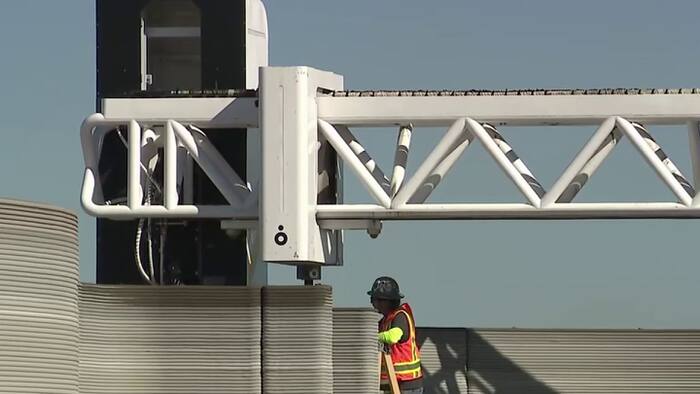
The company is constructing a 12,000-square-foot, two-story facility for ASCO Equipment, which Hurd described as ICON’s largest commercial project to date.
Instead of traditional construction methods, a massive robotic printer builds the structure’s walls layer by layer using a specially developed concrete material called Formcrete.
“The robot went around, took about 45 to 50 minutes. Made that first bead. And then you put one on top of that,” Hurd explained.
According to Hurd, the building’s walls can be printed in approximately three weeks, with just three people needed to operate the robot.
While the technology raises questions about the future of construction jobs, Hurd insists automation is intended to help workers become more productive, not replace them.
“It’s not about eliminating jobs, it’s actually enabling the workforce to do more,” he said.
ICON has already used its technology to construct homes in the Austin area and military barracks at Fort Bliss. Now, Hurd has his sights set on bringing 3D-printed residential construction to his hometown.
When asked how soon San Antonio could see homes built with the technology, Hurd suggested it could happen within the next year.
“Austin was the first, but I want San Antonio to be second,” Hurd said.
The company is also preparing to make its next-generation Titan robotic printer available for other builders to purchase for approximately $800,000.
Hurd said a single robot could potentially construct as many as 100 homes annually.


