Ready to Make Ambient AI Work With Your Existing EHR?
ISHIR helps healthcare organizations engineer secure EHR integrations, healthcare APIs, and AI-powered clinical workflows without replacing existing systems.

Your ambient AI pilot works. Physicians like it. Clinical notes are generated in minutes. Documentation time is coming down.
Then someone asks a question that changes everything.
“If the AI is documenting the entire patient encounter, why are our clinicians still copying information into the EHR, updating orders manually, and switching between three different systems?”
That is where the real challenge begins.
For healthcare CIOs, CTOs, CMIOs, and technology leaders, ambient listening in healthcare is no longer simply about turning conversations into clinical notes. The real opportunity is connecting those conversations to the systems responsible for patient care.
And that is where many promising implementations run into trouble.
Your hospital might use Epic. Another facility in your network runs Oracle Health, formerly Cerner. An acquired specialty practice still depends on a legacy electronic health record system with limited integration capabilities.
Replacing these systems would mean disrupting established clinical workflows, retraining thousands of users, migrating sensitive patient data, and taking on substantial operational risk.
Fortunately, you do not have to replace your EHR to make ambient AI work.
With the right healthcare interoperability architecture, APIs, HL7 FHIR integration, and EHR-specific workflow engineering, healthcare organizations can integrate ambient listening AI into their existing clinical infrastructure.
The challenge is knowing what to connect, how to connect it, and where automation should stop.
Ambient listening in healthcare uses AI-powered speech recognition and natural language processing to capture clinician-patient conversations and generate draft clinical documentation. EHR integration connects that information to the patient’s medical record, clinical workflows, and authorized care teams without requiring clinicians to manually re-enter it.
A typical ambient AI system captures an authorized patient encounter, distinguishes speakers, identifies clinically relevant information, and produces a structured draft note.
However, producing the note is only one part of a clinical workflow.
Consider a routine primary care appointment.
A patient reports persistent fatigue. The physician discusses possible causes, reviews medications, recommends laboratory testing, and schedules a follow-up visit.
An ambient AI tool might document that encounter accurately.
But what happens next?
If those steps still require manual intervention, the organization has improved documentation but has not fully improved the clinical workflow.
Ambient listening becomes more valuable when the information it captures can move safely through existing healthcare systems.
That requires more than a speech-to-text API.
It requires healthcare interoperability.
The first hundred encounters can make an ambient AI implementation look straightforward.
A small group of physicians tests the application. Notes are generated. Feedback is positive. Leadership starts preparing an enterprise rollout.
Then IT discovers that the pilot has only solved one part of a much larger problem.
Many ambient AI products can generate SOAP notes, encounter summaries, and clinical narratives.
But producing a readable note does not mean the receiving EHR can process it correctly.
Different EHR platforms have different requirements for note types, clinical context, author attribution, document status, and workflow permissions.
A document that works in one environment might be rejected, incorrectly categorized, or filed in an unsuitable location in another.
For example, an AI-generated note may be visible in a patient’s chart but unavailable in the physician’s preferred documentation workflow.
Technically, the integration succeeded.
Operationally, it failed.
The solution: Design integration around the receiving EHR’s actual clinical workflow, supported resources, authorization requirements, and note lifecycle, rather than assuming that uploading a document is sufficient.
A health system might have Epic in its flagship hospitals, Oracle Health in regional facilities, and older applications in specialty clinics.
These systems may represent clinical information differently.
Patient identifiers, encounter IDs, note classifications, terminology, and document statuses can vary.
If your ambient AI platform is built around one EHR’s internal model, every additional integration becomes a custom engineering project.
The solution: Introduce a healthcare integration layer that normalizes supported clinical information into a common internal model and translates it into each destination system’s required format.
This does not eliminate EHR-specific development, but it reduces unnecessary duplication.
This is one of the most important technical limitations to investigate before purchasing or developing an ambient AI solution.
FHIR support does not automatically mean full read-and-write interoperability.
An EHR may expose patient demographics, encounters, allergies, and medications through standardized APIs while restricting how external applications create clinical notes or submit orders.
Some functions require additional authorization, organization-specific configuration, or vendor-supported integration mechanisms.
The solution: Evaluate read, create, update, and workflow capabilities separately. Test the exact operations required for the use case before approving enterprise deployment.
Imagine an ambient AI tool captures a physician’s recommendation to change a medication.
The tool identifies the medication, dosage, and frequency.
That does not mean it should automatically change the patient’s prescription.
Medication decisions depend on clinical context, verified patient information, allergies, contraindications, and professional judgment.
An integration that automatically converts every spoken recommendation into an executable order could introduce serious patient safety risks.
The solution: Separate clinical intent extraction from authorized clinical action. AI can prepare structured information or draft orders, but the appropriate licensed clinician must review and approve high-risk actions.
The objective is not maximum automation.
It is reliable automation that preserves clinical accountability.
Epic is a major EHR platform across US health systems, making Epic integration a common requirement for enterprise ambient AI initiatives.
The good news is that organizations do not necessarily need to replace Epic or develop an entirely separate documentation platform.
Epic provides interoperability capabilities through FHIR APIs and other supported integration mechanisms.
Its public technical specifications include FHIR R4 operations for clinical notes, including DocumentReference creation, reading, and searching.
However, availability of a specific interface does not guarantee that every Epic customer environment exposes the same functionality or permissions.
Start by identifying how clinicians will access ambient AI.
Will they launch the application from their Epic workflow? Will the application operate as an embedded or context-aware experience? Or will a background service exchange approved data without requiring users to open a separate interface?
Depending on the use case and supported capabilities, a SMART on FHIR approach can provide authenticated access and clinical context.
The integration team should establish:
The important decision is whether clinicians can use ambient AI without disrupting the workflow they already follow.
An ambient AI application may require access to relevant patient context, such as medications, allergies, encounters, and documented medical history.
Depending on available permissions and APIs, the integration can use FHIR resources such as Patient, Encounter, MedicationRequest, AllergyIntolerance, and Condition.
This context helps the application produce more useful drafts and identify information that requires verification.
But access should follow the minimum necessary principle where applicable.
The application should not retrieve an entire patient record when the clinical workflow only requires a limited set of information.
This is where EHR-specific engineering becomes important.
Suppose ambient AI produces a progress note.
Before transferring that note, the integration must determine the appropriate clinical document type, patient identifier, encounter association, author, and document status.
FHIR DocumentReference may provide a supported mechanism for creating or retrieving clinical documents.
However, the integration must validate whether the target Epic configuration supports the required note-creation workflow and how imported content is reviewed and signed.
A successful API response alone does not prove that the note is correctly positioned within the clinician’s workflow.
Ambient AI should not bypass clinical documentation approval.
The system should support a controlled process in which the clinician reviews, corrects, and approves the generated documentation before finalization.
This requires careful handling of draft states, revisions, author attribution, and signing workflows.
Where an EHR API does not support the desired draft lifecycle, the application may need to maintain its own secure review workflow and use an approved EHR mechanism for final submission.
The integration must be designed around actual vendor capabilities rather than assumed functionality.
For healthcare technology leaders, the goal is simple: Make ambient AI work within Epic, not force clinicians to work around another disconnected application.
Reference: Epic’s official FHIR interface specifications
Organizations using Oracle Health face a similar challenge, but the integration details are not identical.
Oracle Health’s Millennium platform provides FHIR R4 APIs and EHR-specific interfaces for accessing clinical information.
Its published API documentation includes operations involving patient records, encounters, documents, and other clinical resources.
Importantly, Oracle Health also documents a FHIR R4 DocumentReference create operation.
That creates an integration path worth investigating for ambient AI documentation.
However, there is a critical technical distinction.
Oracle Health’s documented DocumentReference create operation supports final documentation for provider-authorized access, rather than an unrestricted draft-note workflow.
A healthcare organization should not assume that creating a document through an API is equivalent to placing an unsigned ambient AI draft into its native clinician review process.
First, establish the patient and encounter context through supported interfaces.
Second, retrieve only the clinical information needed by the ambient AI application.
Third, generate structured documentation using the authorized patient encounter.
Fourth, make the output available for clinician review through an approved workflow.
Fifth, submit the appropriate document through supported Oracle Health mechanisms after the required review and authorization.
Finally, verify that the document appears in the expected location with correct patient, encounter, author, and status information.
For more advanced functionality, such as order preparation or workflow triggers, the team must separately validate each supported API and clinical permission.
Oracle Health has also expanded its own AI capabilities for clinical documentation and workflow assistance.
That means healthcare CIOs should evaluate whether their requirements are best handled through native features, third-party integration, or a customized application.
The decision should depend on workflow requirements, extensibility, cost, and clinical governance.
Legacy EHR integration is often more difficult because older systems may not support modern FHIR APIs.
Some still depend on HL7 v2 messaging, proprietary interfaces, database exports, or tightly controlled integration engines.
Others support limited interoperability but lack the capabilities required for modern ambient AI workflows.
This raises a familiar question for healthcare CIOs:
“Do we need to replace our legacy EHR before introducing ambient AI?”
In many cases, no.
A well-designed integration layer can connect newer ambient AI applications to older clinical systems without requiring a full EHR replacement.
HL7 v2 remains widely used in healthcare interoperability.
Depending on the system, supported messages may provide access to patient administration events, clinical observations, or certain document workflows.
For example, ADT messages can help maintain patient and encounter context, while some systems use MDM messages for medical document exchange.
The precise implementation depends on the legacy EHR’s interface specifications and licensed capabilities.
If the legacy application lacks suitable APIs, an integration service can provide a controlled interface between the ambient AI platform and the EHR’s supported inbound mechanisms.
This layer can perform data validation, terminology mapping, message transformation, authentication, logging, and delivery monitoring.
For example:
Ambient AI generates a structured clinical note.
The integration layer validates the patient and encounter.
The system maps the content into a document format supported by the destination EHR.
The note is then delivered through an approved interface and routed for the required clinical review.
This allows the ambient AI application to evolve without tightly coupling it to every internal detail of the legacy platform.
Healthcare integration engines can help orchestrate data movement across systems using different protocols and formats.
Depending on the existing technology environment, tools such as NextGen Connect or enterprise integration platforms may support the required interfaces.
The important consideration is not the integration engine itself.
It is whether the architecture provides reliable message delivery, traceability, security, and clinical data integrity.
Some legacy EHRs offer no suitable standards-based write interface.
In these environments, organizations may evaluate vendor-supported file interfaces, document import mechanisms, or other approved integration approaches.
Screen-level automation should be considered only when supported interfaces are unavailable and the operational risks can be adequately controlled.
Direct database writes into an EHR should not be treated as a shortcut. They may bypass validation, audit controls, and vendor-supported clinical workflows.
The right legacy modernization strategy is not necessarily replacing everything. It is creating a safe interoperability path while preserving the systems that still support patient care.
A scalable ambient listening implementation needs more than a connection between a microphone and an EHR.
It needs a reliable architecture that separates clinical information capture, AI processing, integration, and authorized EHR actions.
A practical architecture involves six layers.
The system captures an encounter only under the healthcare organization’s applicable authorization, privacy, and consent policies.
Audio capture must be governed by appropriate security controls and retention rules.
The ambient AI application converts authorized speech into text, distinguishes speakers, identifies clinical concepts, and generates a draft note.
The system should identify uncertainty rather than silently invent missing information.
Relevant EHR context is retrieved through approved interfaces.
The application checks identifiers, terminology, encounter association, and any available supporting clinical data.
AI-generated information remains distinguishable from verified EHR information.
This layer connects the ambient AI product to the receiving clinical systems.
It may use FHIR R4 APIs, SMART on FHIR authorization, HL7 v2 messages, or approved vendor-specific interfaces.
It also handles transformations, routing, retries, exception management, and audit events.
Before the system submits sensitive clinical actions, the appropriate clinician reviews and approves them.
Documentation, orders, referrals, and follow-up tasks should be handled according to their individual workflows and risk levels.
The integration writes or transfers approved information using supported interfaces.
Operational monitoring confirms that information reached the correct system, patient, encounter, and workflow destination.
This is particularly important when a health system operates multiple EHR platforms.
The architecture must account for failed messages, duplicate submissions, unavailable interfaces, and interrupted encounters.
An enterprise-ready ambient AI system needs to know not just what information was generated, but whether that information arrived safely and correctly.
Healthcare organizations should approach integration as a staged engineering initiative, not a standalone software installation.
Identify every EHR platform involved, the clinical departments using it, current integration interfaces, and existing workflow dependencies.
Document where patient information originates, where notes are reviewed, and which systems receive downstream clinical data.
The result should be a clear picture of what already works and where interoperability gaps exist.
Do not start with a list of AI features.
Start with the operational problem.
Are physicians spending excessive time on documentation?
Are clinical notes being copied between applications?
Are follow-up tasks being missed or duplicated?
Is poor integration preventing the organization from expanding an otherwise successful pilot?
Translate each issue into a measurable objective.
For example, reducing duplicate data entry may be a more useful target than increasing the number of AI-generated notes.
Confirm exactly what the target EHR permits.
Test authentication, access permissions, supported FHIR resources, document creation, encounter association, and required clinician review.
For legacy systems, evaluate available HL7 interfaces and document import mechanisms.
This step should happen before committing to an enterprise implementation roadmap.
Where multiple EHRs are involved, develop reusable components for identity mapping, terminology translation, clinical note processing, audit logging, and exception handling.
Keep EHR-specific adapters separate from the core ambient AI application where practical.
This makes future platform upgrades and additional integrations easier to manage.
Ambient AI workflows handle highly sensitive patient information.
The organization must assess applicable HIPAA requirements, business associate agreements, access controls, encryption, auditability, and incident response.
Patient consent requirements also need to account for applicable federal and state laws, including relevant recording and privacy requirements.
Clinical safeguards must include appropriate human review and procedures for correcting inaccurate documentation.
A technical connection is not enough.
Testing should cover the complete workflow from authorized recording to reviewed documentation appearing correctly in the EHR.
Test scenarios should include:
Clinical users should participate in acceptance testing before production expansion.
Begin with a bounded clinical workflow, selected specialties, and a manageable number of clinicians.
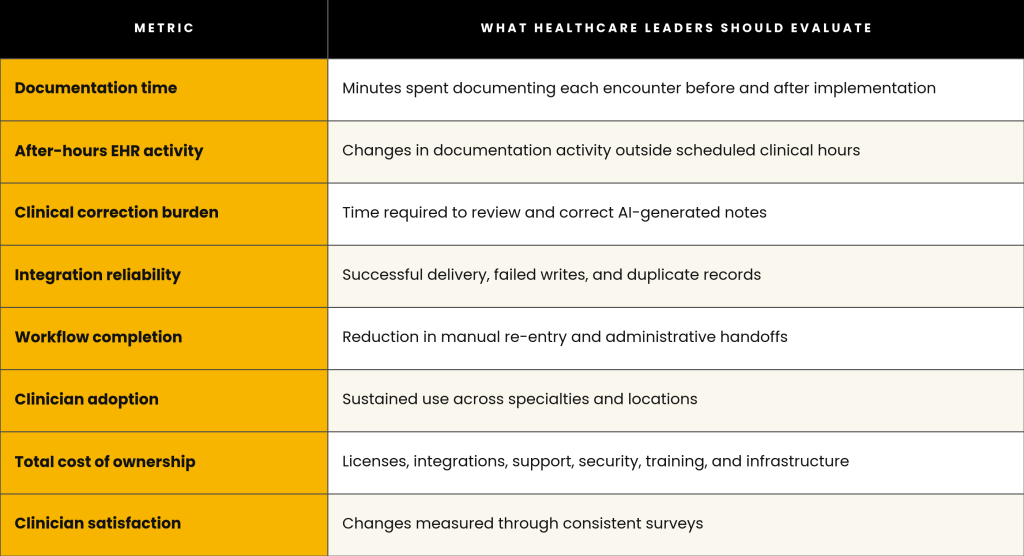
Measure documentation time, correction rates, integration failures, clinician adoption, and after-hours EHR activity.
Expand only when the technical and clinical performance meets agreed acceptance criteria.
A successful pilot proves that the technology may work.
A successful enterprise implementation proves that it works reliably within the organization’s operating environment.
For US healthcare executives, the business case needs to go beyond the volume of notes generated.
A product that creates thousands of AI notes but leaves clinicians correcting documents and manually completing downstream tasks may deliver less value than expected.
The ROI assessment should consider both benefits and costs.
A simple financial model can estimate:
Annual net benefit = Verified annual operating savings + attributable additional contribution margin − annualized implementation and operating costs.
But not every recovered minute translates into revenue.
Some savings improve clinician experience or reduce after-hours work without increasing appointment capacity.
Similarly, reduced burnout should not automatically be counted as physician retention savings without supporting evidence.
The strongest ROI models distinguish between time recovered, costs actually avoided, and additional revenue genuinely realized.
Ambient AI introduces sensitive data flows that extend beyond the existing EHR.
Audio recordings, transcripts, generated notes, and clinical context may pass through AI services, cloud infrastructure, and integration platforms.
That means security cannot be treated as an afterthought.
Healthcare organizations should verify:
1. Which vendors and subprocessors create, receive, maintain, or transmit electronic protected health information.
2. Whether required business associate agreements are in place.
3. How audio, transcripts, and generated documentation are encrypted and retained.
4. Whether patient consent and recording preferences are captured appropriately.
5. How user permissions and patient access restrictions are enforced.
6. Whether AI providers are permitted to use clinical information for model training.
7. How incidents, inaccurate records, and unauthorized access are identified and addressed.
The US Department of Health and Human Services confirms that cloud service providers handling electronic protected health information on behalf of covered entities or business associates are generally business associates, with corresponding HIPAA obligations.
A vendor’s statement that its product is HIPAA-compliant is not sufficient evidence that the entire integrated workflow meets the organization’s obligations.
Compliance depends on how the complete system is designed, configured, governed, and operated.
Reference: HHS Guidance on HIPAA and Cloud Computing
Healthcare organizations do not need another disconnected application that adds complexity to an already fragmented IT environment.
They need solutions that work with existing systems, respect clinical workflows, and can scale safely.
ISHIR helps healthcare organizations and HealthTech companies address these challenges through healthcare software engineering, AI integration, application modernization, and interoperability-focused development.
Every implementation should be designed around the healthcare organization’s specific EHR environment, clinical requirements, security responsibilities, and vendor-supported interfaces.
The real opportunity is not to make your existing EHR obsolete. It is to make that EHR more useful by connecting it to the next generation of healthcare AI.
ISHIR helps healthcare organizations engineer secure EHR integrations, healthcare APIs, and AI-powered clinical workflows without replacing existing systems.
Yes. Epic provides FHIR APIs and other interoperability capabilities that can support third-party clinical applications. The specific integration depends on the Epic deployment, enabled interfaces, authorization, and required documentation workflow. Organizations should verify supported note-writing and review capabilities before implementation.
Oracle Health Millennium offers FHIR R4 APIs that support access to clinical information and specific document operations. Integration generally involves authenticated access, patient and encounter mapping, document transformation, clinician review, and approved submission. Draft-note and final-document workflows must be evaluated separately.
Yes, in some environments. Integration may be possible through existing HL7 v2 interfaces, vendor-supported APIs, document import capabilities, or healthcare middleware. The available approach depends on the legacy application’s technical interfaces, vendor restrictions, and clinical workflow requirements.
Ambient AI documentation converts clinical conversations into draft notes. EHR workflow integration connects those notes and other approved information to existing clinical systems. It also involves patient identification, encounter mapping, authorization, review, delivery monitoring, and potential downstream workflow coordination.
No. SMART on FHIR supports standardized application authorization and integration capabilities, but actual write operations depend on the EHR’s supported APIs, scopes, and configuration. A successful SMART launch does not guarantee that an application can create unsigned notes, place orders, or complete clinical workflows.
There is no reliable universal timeline. A limited integration using existing approved interfaces may be substantially simpler than deploying across multiple EHR platforms. Complexity depends on vendor approvals, API availability, security assessments, workflow configuration, clinical testing, and legacy system limitations. An integration feasibility assessment should establish realistic scope and delivery milestones.
Ambient listening technology is not automatically HIPAA-compliant simply because it is designed for healthcare. Compliance depends on how patient information is captured, transmitted, processed, stored, accessed, and governed. Required business associate agreements, security safeguards, privacy policies, and applicable consent requirements must be evaluated across the complete solution.
Ambient AI may be able to extract clinical intent and prepare structured information for supported workflows. However, creating or submitting clinical orders requires appropriate EHR capabilities, authorization, validation, and professional oversight. High-risk clinical actions should not be executed solely from an unverified AI interpretation of a conversation.
Healthcare organizations should evaluate existing solutions first when their requirements are primarily standard clinical documentation. Custom development may be justified when organizations need specialized workflows, proprietary functionality, unique integrations, or differentiated HealthTech products. A build-versus-buy assessment should consider clinical safety, integration costs, ownership, scalability, and long-term maintenance.
They should evaluate EHR compatibility, clinical documentation accuracy, workflow integration, data security, clinician adoption, interface reliability, total cost of ownership, and measurable operating outcomes. The most important question is whether the technology reduces the entire clinical documentation burden rather than simply generating notes faster.
The post How to Integrate Ambient Listening AI With Epic, Oracle Health, and Legacy EHR Systems Without Replacing Them appeared first on ISHIR | Custom AI Software Development Dallas Fort-Worth Texas.


