
Subscribe to The Y’all — a weekly dispatch about the people, places and policies defining Texas, produced by Texas Tribune journalists living in communities across the state.
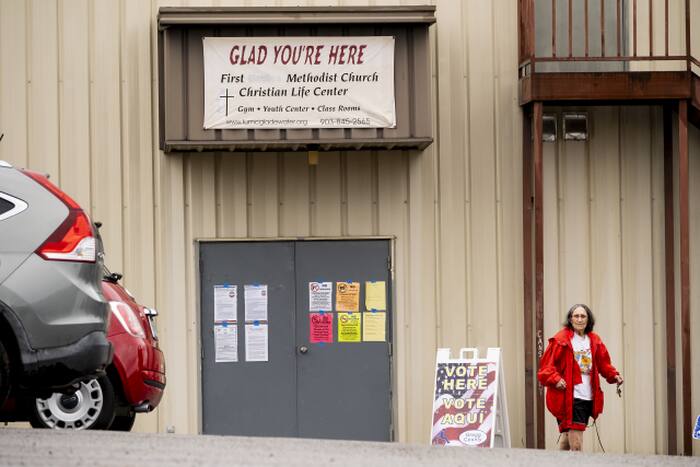
LUFKIN — Texas Republicans lost considerable ground in rural Texas Tuesday night, a significant factor in the party’s historic wipeout.
Voters in many of the state’s most reliable red counties either stayed home or did the once unthinkable and pulled the lever for a Democrat, a Texas Tribune analysis found.
Roughly 90% of the counties that saw a decrease in voter turnout were rural.
And state Rep. James Talarico, who made history by becoming the first Democrat to win one of Texas’ U.S. Senate seats since 1988, closed the gap with Republican voters in rural counties by about 10 percentage points since 2018, data shows. And he outperformed Beto O’Rourke’s 2018 margin in exurban counties by about 15 percentage points.
Taralico’s performance — while not a knockout in places like Midland and Nacogdoches — should serve as a warning call to Republicans, said Drew Landry, a political science professor at South Plains College in Levelland.
“This tells us that you can’t take rural Texas for granted,” Landry said. “Republicans were really trying everything to gin up support, but they didn’t want to talk about the big issues, and they paid the political price for it.”
Democrats in other statewide races also outperformed in rural areas, including Clayton Tucker, who will become the first Democrat to lead the state’s agricultural department since 1990. Tucker formed a quasi-alliance with outgoing commissioner Sid Miller, who lost the Republican primary in March. Miller suggested for months a doomsday scenario for Republicans.
To be sure, Democrats are still far from winning the rural Texas vote outright. However, the party long out of power in Texas made monumental inroads that propelled them to the top. Now, the question is: What can they do to keep that momentum going?
“We just need somebody to come over here and not stay, but come through every now and then and ask if we’re doing alright,” said Guessippina Bonner, a former Lufkin City Council member. “People would respond to that.”
Texas voters broke turnout records, including in rural and exurban counties. However, the increase was not uniform. Urban voters increased their turnout by nearly 8 points since 2022. Meanwhile, rural voters only picked up the pace by about 1.4 points.
Voters along the Louisiana border and in central West Texas, in particular, appeared to stay home. Meanwhile, voting participation increased along the southern border and in the Panhandle.
Bonner, who has served as a sounding board for many East Texans, said her Republican friends were discouraged by the choices they were given.
“There were Republicans here in East Texas that sat out, did not go to vote,” Bonner said. “Because they didn’t appreciate and didn’t adhere to what was being said by the party.”
Rural counties typically make up less than 10% of the total votes cast in Texas, according to Tribune data. Rural votes accounted for about 9% of the total votes cast in 2022. In 2026, that percentage dropped to about 8%.
Put another way, about 800,000 rural Texans voted this year, compared to about 1.3 million who cast a ballot in Harris County, the state’s most populous county that includes Houston, at the same time.
“Republicans lost because they didn’t give rural Texas enough of a reason to show up,” said Suzanne Bellsnyder, a conservative political analyst who worked for Gina Hinojosa’s winning gubernatorial campaign. “They lost their insurance policy.”
Bellsnyder, who also publishes a Panhandle newspaper, saw the number of Democratic votes double from 50 to 100 — a significant jump for the county of around 5,000.
In Lubbock County, a historically ruby-red stronghold for Republicans, Talarico won nearly 41% of the vote compared to O’Rourke who won 35% in his 2018 Senate bid.
The last Democrat to win 40% of the votes in Lubbock County, Landry said, was Ann Richards in 1990.
“That’s tremendous,” Landry said. “That’s what Democrats have always needed in a place like out here.”
Rural voters went unheard
Rural voters likely had a long list of issues that influenced their vote.
Landry, the political scientist, said the discourse around public education funding and data centers, along with national frustrations such as high grocery and gas prices, appeared to be the biggest motivating factors for rural voters.
And Republicans weren’t talking about how to solve them.
Instead, Landry said Republicans focused on hyper-political social issues, such as removing transgender rights, and it didn’t land with voters.
“Usually the Republicans have a lot of momentum going into these rural areas to where it wouldn’t matter what Democrats say,” Landry said. “They didn’t want to talk about data centers or the economy, and this was the one instance where the answer was staring them right in the face and for the first time in 30 years, they missed.”
Miller put the blame on Gov. Greg Abbott, who lost his own reelection effort, and his crusade for a private school voucher program, which was unpopular in rural Texas.
“Rural Texas didn’t have anybody to vote for tonight,” Miller said. “They felt betrayed.”
Miller said Texans made their concerns on data centers, the THC ban, school vouchers or transmission lines before the GOP’s devastating losses on Tuesday. However, he said all Republicans quit listening to the people and focused on their donors instead.
“When you quit listening to the people, you deserve to lose and that’s what happened,” Miller said.
Democrats, on the other hand, had a message voters resonated with. They focused on affordability, public schools and data centers, Bellsnyder said.
Democrats can build on the gains they made this year if they keep focused on those issues, Landry said.
“Democrats still need to go out and earn votes,” Landry said. “Whatever has been done here could either be expanded, or it can be completely reset come 2028.”


